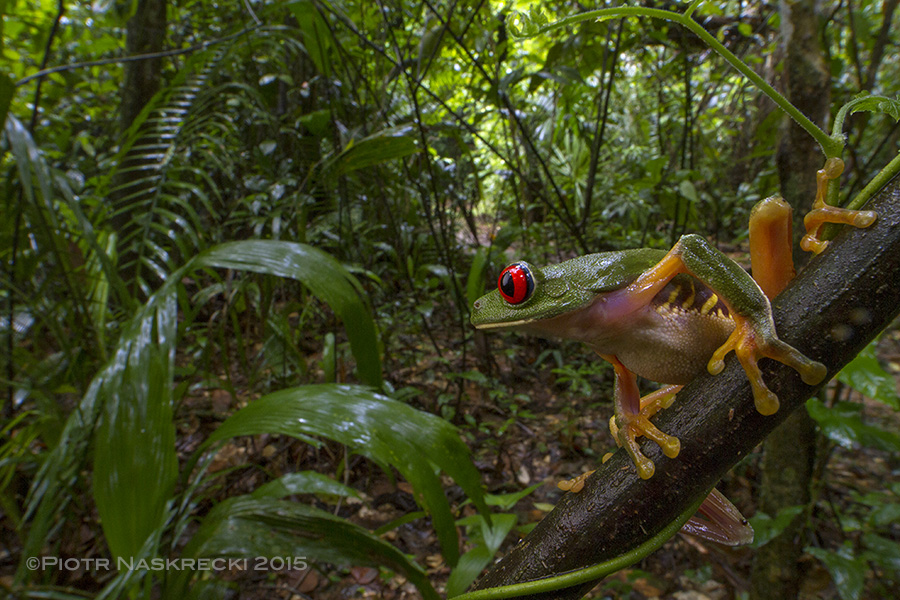
I almost got away with it – for five days I had covered my body and slathered insect repellant onto my skin with an almost religious zeal, but on the last day I faltered. I was in Belize, teaching macrophotography at the Bugshot workshop. The course was almost over, and so I relaxed and decided to shoot some red-eyed tree frogs in the rainforest around the lodge. I rolled up my sleeves but, because I had misplaced my insect repellant and was too lazy to look for it, I did not put any DEET on. Big mistake. As I photographed the frogs, clouds of mosquitos, perhaps sensing a new, unprotected warm body, went to town on my arms and face. But, this being my last day in Belize, I decided to ignore the little vampires and kept taking pictures. Later that day my arms were quite itchy, but it was nothing new or unusual.
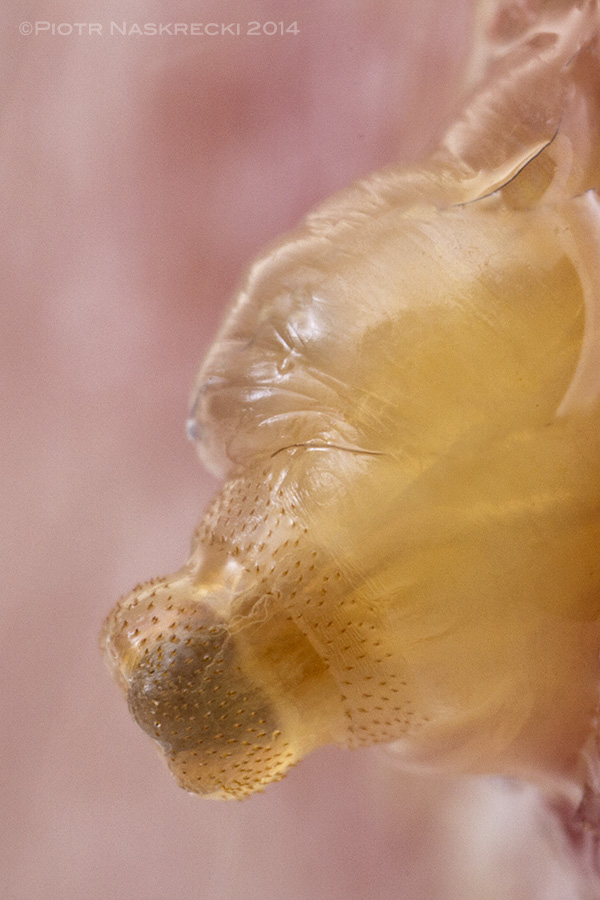
Things started veering off course after I got home. Some of the mosquito bites kept itching and, rather than disappearing, started to get bigger. It didn’t take me long to realize that I had brought with me, embedded in tiny holes in my skin, larvae of the Human bot fly (Dermatobia hominis). This was not the first time for me to have this parasite. What was new was the number of these animals that had made my body their home – at least six of them were feeding on both my arms, with four spaced only a millimeter apart on my right forearm. In the end, only three of them survived the first week. One of the surviving larvae was on my elbow. It was a nasty little thing, very active and painful. It had to go. But I decided to keep the two remaining larvae. As strange as it sounds, I felt bad about killing them, but I also had never seen an adult bot fly, and this was my chance.
Human bot flies are well known to entomologists and people living in warm, tropical parts of Central and South America. I cannot think of any of my biologist friends working there who didn’t have a torsalo living in their skin at some point or another, often in such very inconvenient places as the eyelid, the upper lip, or the top of the head. These get extracted through a variety of methods that often involve suffocating the larva with glycerine jelly, raw steak, or duct tape, and then pulling or squeezing the larva out of the skin. These methods usually work, but there is always a risk of leaving a part of the bot’s body in the wound, which may lead to infection. On those occasions where I needed to remove a larva, I preferred to use a suction venom extractor, which enlarges the opening of the wound (warble) and pulls the larva out, still alive and in one piece. I only discovered this method, first described 13 years ago (Boggild et al. 2002. Clin. Infect. Dis. 35: 336-8), after a visit to my doctor. Her solution was to perform a surgery by cutting my arm open. I said “thanks, but no thanks” and did my own research on furuncular myasis.
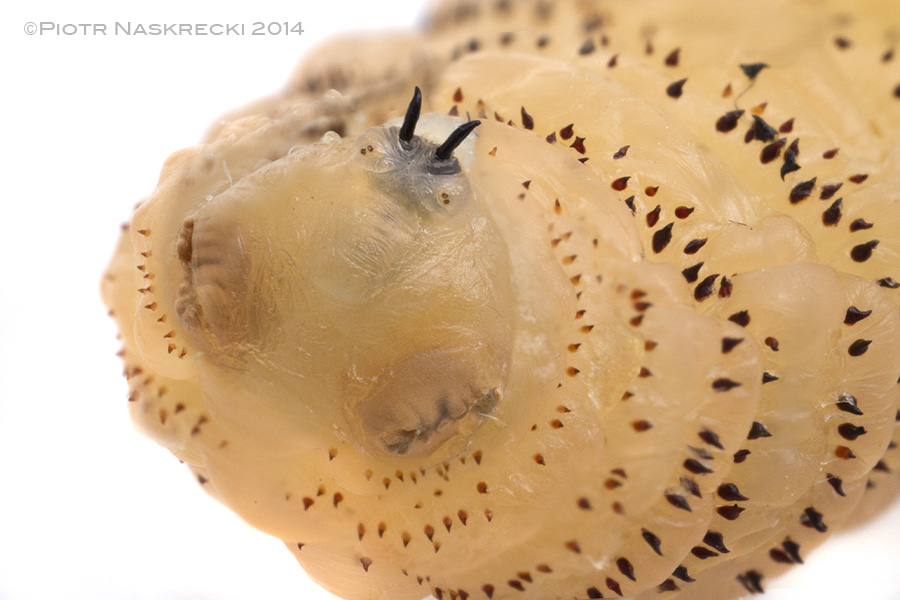
Human bot flies (D. hominis), despite their name, are not interested in our species only. They will gladly feed on other primates, as well as ungulates and other large mammals. Similarly, other members of the bot fly family (Oesteridae), who preferentially target small mammals, will occasionally find themselves on humans. But we get infected with D. hominis more often than with other bot flies because of this species’ unusual strategy of dispersing its eggs. Rather than laying them on the ground in the vicinity of mammalian burrows, the way other bot flies do, the D. hominis female catches and lays her eggs on other exoparasites: mosquitos, ticks, and deer flies. The eggs hatch while on the intermediate host and drop onto the skin of the ultimate host, often a human, when they sense its body heat. Frequently they will use the hole made by the mosquito to enter the skin but they can also use a hair follicle to get inside. Even the newly hatched larvae are covered with spines that point up, which makes pulling them out from the warble very difficult.
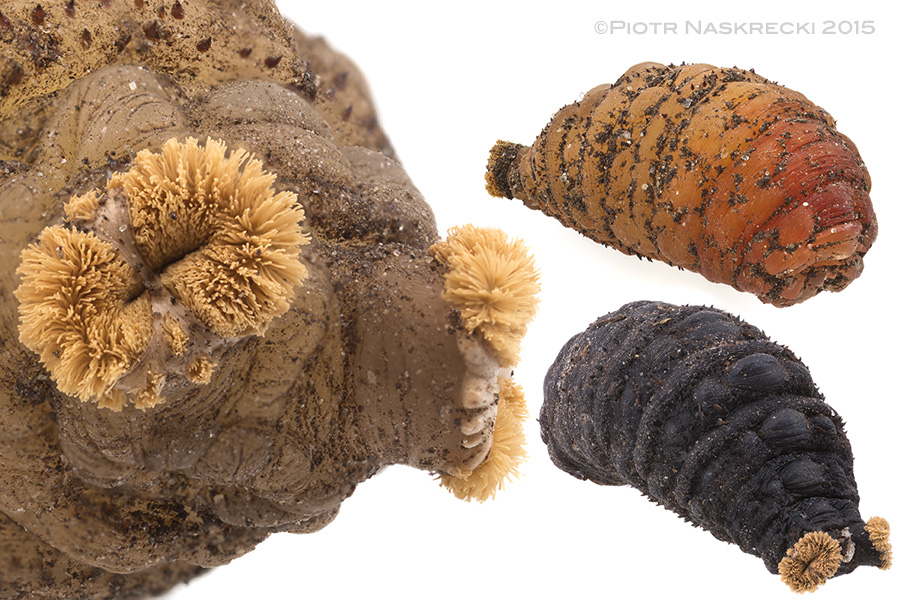
Once in the skin, the larva undergoes three molts and in 7-10 weeks grows from the size of a grain of sugar to that of a peanut. Throughout this time the warble enlarges and occasionally bleeds, but otherwise it is relatively painless, unless the larva decides to munch on nerve endings. These wounds rarely get infected as the larva very likely produces antibiotic secretions. Once fully grown, the larva crawls out of the warble and falls to the ground, where it quickly buries itself and turns into a puparium. The wound usually heals completely within a couple of days. All in all, not a big deal. But some people, for whatever reason, don’t like to have a squishy, almost harmless animal living in their skin.

A mounting body of research indicates that many parasites have evolved a way of manipulating the behavior of their hosts. A parasitic horsehair worm will make its otherwise terrestrial grasshopper jump into the water, where it then ruptures the grasshopper’s body and swims away. Parasitoid wasps who have just left the emaciated body of a caterpillar will be actively protected by their brain-washed host. Humans also fall victim to parasitic manipulation – there is evidence that toxoplasmosis, a disease caused by protozoan Toxoplasma gondii, makes men less intelligent and prone to take greater risks (it has to do with increasing the likelihood of ending up as food for large cats, Toxoplasma’s ultimate host; inexplicably, the effect on women is a statistically significant increase in their intelligence.)
After I had decided to keep two of my botflies and let them reach maturity, I began to wonder – have the generations of entomologists, who let these flies live in their skin as a kind of geeky right of passage, inadvertently selected for a strain of bot flies that manipulate human behavior towards letting the flies live? Or do I just have toxoplasmosis?

In any case, the flies survived in my skin for nearly 10 weeks, successfully emerged, pupated, and are now enjoying a brief life as adults. Brief, because adult bot flies have no functional mouthparts and cannot feed, which means that they only live for a few days. They are quite pretty – I would go as far as to say that, among insects, they undergo one of the most dramatic transitions from ugly to cute during their development.
It was an interesting experience and I am glad that I managed to bring these insects to maturity. But rest assured that the next time I am in Belize my bottle of DEET will never leave my pocket.
Stay tuned for a video with some awesome sequences showing the development of my bot fly!
Update: The video is now available.

Postscript
I let my bot flies live and I went to great pains to make sure that they survived their inadvertent exodus from their native land of Belize. Will this endear me to people who wanted to crucify me for killing a puppy-sized spider a few months ago? I am guessing, no. Do I give a crap? Take a guess. Incidentally, now that the dust has mostly settled, I can repeat that I did not kill the puppy-sized spider – another scientist collected and preserved it – although this bit of information somehow didn’t register with the online media. There was no point in clarifying this because it is completely irrelevant to the issue of scientific collecting – I have killed and preserved my share of specimens, and I will always defend biologists who have the unpleasant duty to do so.
Postscript 2
Gil Wizen has written about his experience of raising a dipteran child on his blog.

 The Smaller Majority
Helpful info. Lucky me I found your website by chance,
and I am surprised why this coincidence didn’t took place earlier!
I bookmarked it.
It took a bit of digging to find the true article on this, but it was more than worth it. The adult botfly looks amazing. I could only imagine how incredibly crazy their short life must be, and what they can see with those incredible eyes.
The puparium stage looks like so many marine invertebrates that I’ve seen before. It just reminds me of how much our world is linked together. Would you happen to know if the botfly larvae’s barbs are able to be retracted? I’m curious because I feel it would make their lives easier when the time comes to leave their mammalian host.
Sorry for this maybe stupid question, but wont those flies now start biting people in your area? Didnt you just bring a new parasite to wherever is it you live?
I actually feel pretty bad for the spider after having read about the miserable and totally repulsive botfly maggots! The spider is so much more esthetically pleading, for Pete’s sake! Where’s your sense of art, ha ha!
This is a fascinating story. You say that some people for some reason don’t like the poor little animal living in their skin. After seeing a video I would rather chop my arm off then let it live in my skin, it scared me so much. You must really love all leaving creatures ;))
Wait. You’re the scientist who fed the puppy to that giant spider? Or fed the spider to the giant puppy? I can’t remember which. Either way, you’re a monster for having done whatever it is you did which was, clearly, awful.
No idiot. He found a goliath tarantula and killed it. Some said it was the size of a puppy. Perhaps he doesn’t value how long it took this creature to get this big. As a tarantula owner myself this would’ve taken a long time to get this big only to have gotten killed for coming across this ‘scientists’ path.
Perhaps it was only the size of a teacup Chihuahua puppy which is still large for a spider but hardly worthy of ‘goliath’ status. If so, you owe Mr. Nastrecki an apology. I, on the other hand, have no issue with him collecting spiders or chihuahua’s. Both are strange, terrible beasts that pose grave threats to our well being.
You do realize that you are intentionally killing hundreds if not thousands of animals by keeping tarantulas, right? A cricket (or whatever you feed your tarantulas) probably does not have a fun time once released into your tarantula enclosure (cage) without a way to escape. Don’t you value how long it took the crickets to get as big as they were?
Please give us ‘scientists’ a break. We appreciate the animals we study more than most people.
I’d say entemologists have inadvertently selected a strain of botfly that likes to be captured on film and is something of a PR genius. This is great, fascinating work.
The eggs hatch while on the intermediate host and drop onto the skin of the ultimate host, often a human, when they sense its body heat. Frequently they will use the hole made by the mosquito to enter the skin but they can also use a hair follicle to get inside. Even the newly hatched larvae are covered with spines that point up, which makes pulling them out from the warble very difficult. odstar
With the title of this post, I thought surely you were going to tell us about some weirdo border agents or activists stopping you because of your smuggling activities!
I must admit that I’m completely overwhelmed that you (and some others) keep the botfly larvae and let them mature. Such dedication to science, Piotr! While I would totally freak out were that to happen to me, I thoroughly enjoy reading about such experiences and seeing the wonderful photos.
Keep up the good work, you nasty puppy-killing smuggler!! ;)
Hi Piotr
Happy New Year! In case you haven’t seen the paper by Fritz Dieterlen (in German):
http://biodiversitylibrary.org/page/33534073
Cheers, Jakob
I always thought Cephenemya stimulator was rather adorable: http://upload.wikimedia.org/wikipedia/commons/b/b7/Cephenemya_stimulator.jpg
Beautiful images and engaging prose, as always!
Great photos! It sure would be nice if you could put some of them on Wikimedia Commons so when people write about botflies for the world’s encyclopedia they have access to some great photos. My students writing on wasps last semester really struggled to find good photographs. I understand making a living from photos, but I also understand the satisfaction of having lots of people use your photos. So please share a few with a CC BY SA license.
Your description of the botfly life cycle is fascinating. But it raises a question. What sorts of research methods are needed to learn that the fly lays its eggs on mosquitoes etc., and, of course, how does the rest of the life cycle get mapped?
Fascinating, enlightening, and entertaining. Although I am glad that botfly larvae are not puppy-sized…
OK, so, I’m one of those people who work in Guyana and was annoyed by so many things about the goliath spider story… but indeed I am slightly swayed by your telling of this tale. And, kudos X 1000 on the imagery. Whoa.
I brought home at least one bot fly in 1986 on my first trip to Belize, with absolutely no idea what was going on. Thinking I was popping a bad pimple, I got a ghastly and confusing surprise when a squirming little dotted worm flew out onto my bathroom countertop.
I brought the specimen to a doctor in Denver thinking I was surely near death from something dramatic and dire coursing through my body. His clinic spent a week trying to figure out what was going on, to no avail. Clearly, the staff there had no more experience with the tropics than I did at that point. Sigh.
It was only a decade later when an entomologist friend enlightened me about what had transpired. And, now, today, a vivid visual to add to my botfly understanding. Thanks!
I’m curious, Michael- what about the goliath story, as Piotr told it, annoyed you? Are you anti-collecting?
you are a brave man !
Fantastic post, Piotr and the photos are stunning! I shared a similar experience in Belize back in 1984 when six ‘beefworms’ infected my head. Needless to say, the pain was excruciating but, like you, I allowed one of them to almost mature just to get some photos of the little beast (although no where near as superb as your photos). And, while I’m not an entomologist (I’m a herpetologist), I could still appreciate the fascinating life cycle these creatures go through. Thank you for sharing your story and for giving me flashbacks to my experiences from over 30 years ago. Kudos on a well-written and well documented story!
DEET doesn’t always work. Some years ago I undertook a trek from the Southern highway to the headwaters of the Manatee river in Belize. I had been greatly troubled by “beefworms” on previous trips so this time I was prepared. All of my clothes were saturated with twice the legal amount of Permethrin and I slathered myself with DEET. Dermatobia particularly favors heads, so I wore a tight bandana completely saturated with poison. I have had many beefworms so I have learned to recognise the particular feel of the tiny maggots digging into skin. It was clear to me that numerous little maggots were digging their way into my scalp but there was nothing I could do about it. Besides, I was too busy being ravaged by “bottlas” flies (blackflies), doctor flies, billions of ticks, and worst of all the deadly (to me) bullthorn antcacia ants which had rendered my left arm useless. The following day I discovered to my horror that my legs were infested with cutaneous larvae migrans I acquired by simply looking at jaguar shit. Then there was the flood that swept away our camp with all supplies, food, etc. With all the excitement I simply ignored the worms in my head. After a week had gone by the little volcanos could be counted so I discovered that 13 had somehow gotten past a bandanna saturated with double dose of both Permethrin and DEET. There was one that I was unable to extract and it is still in my head today. My girlfriend being a good scientist like Piotr let two of hers mature. As shown above the mature maggots are extraordinarily large, so I will not soon forget parting her hair to examine the mini volcanos inside of which the huge larvae looked like wriggling brain tissue.
A brilliant blog entry Piotr – a great read, ‘real’ science and superb images.
Fascinating !!! Keep sharing your experiences with us. Love it!
Sorry for the repeated comment! But great work like this deserves many kudos.
Congratulations! The Holy Grail of neotropical entomologists! Successful pupaption AND great photos! Well done!
Great! The Holy Grail of neotropical entomologists! Successful pupaption AND great photos! Well done!